

Oxidative stress is recognized as a central pathological mechanism contributing to the progression of diabetes and its associated complications. Persistent hyperglycemia promotes excessive reactive oxygen species (ROS) production, mitochondrial dysfunction, chronic inflammation, and apoptosis, ultimately leading to tissue injury across multiple organs.
Increasing evidence suggests that oxidative stress plays a critical role in diabetic nephropathy, cardiomyopathy, retinal injury, impaired wound healing, and reproductive dysfunction. As a result, oxidative stress-related biomarkers and inflammatory pathways have become widely investigated targets in diabetes research.
Research Application Overview
This page summarizes representative peer-reviewed studies demonstrating how Elabscience® reagents have been applied in oxidative stress-related diabetes research workflows, including inflammatory cytokine analysis, mitochondrial dysfunction studies, apoptosis evaluation, and signaling pathway investigation.
Research Scope at a Glance
• Disease / Field: Diabetes Mellitus
• Key Research Focus: Oxidative stress, mitochondrial dysfunction, inflammation, apoptosis
• Experimental Models: STZ-induced diabetic rats, diabetic mice, HK-2 cells, patient samples
• Common Assays: ELISA-based cytokine analysis, oxidative stress and ROS assays, apoptosis detection, mitochondrial function assays
Literature-Based Experimental Application Matrix
The table below summarizes how Elabscience® reagents have been used across peer-reviewed studies in this research area.
Table 1. Literature-Based Application Matrix of Elabscience® Reagents in Diabetic Research
|
Research Focus |
Model |
Assay/Method |
Key Outcome |
Reference |
|
|
Diabetic renal injury |
STZ diabetic rat + HK-2 cells |
ROS detection, ELISA, apoptosis assays |
Rat TNF-α ELISA Kit (E-EL-R2856), (E-EL-R0012) |
↑ ROS accumulation in renal tissue; ↑ TNF-α and IL-1β secretion; ↑apoptotic signaling (Bax/Bcl-2, cleaved caspase-3); activation of Nrf2/HO-1 pathway and suppression of TLR4/NF-κB signaling. Resveratrol reduced oxidative stress, inflammation, and apoptosis during diabetic renal I/R injury. |
[1] Gong et al., Renal Failure (2026) |
|
Mitochondrial oxidative stress |
T2DM mouse lung tissue |
Cytokine profiling, mitochondrial function assays |
High Sensitivity Mouse IL-1β ELISA Kit (E-HSEL-M0001), High Sensitivity Mouse IFN-γ ELISA Kit (E-HSEL-M0007), High Sensitivity Mouse IL-17A ELISA Kit (E-HSEL-M0005) |
inflammatory cytokines (↑ IL-1β, ↑ IFN-γ, ↓ IL-17A); antioxidant enzyme activity (↓ MnSOD, CAT disordered); impaired mitochondrial function (PGC-1α, AMPK dysregulation). Oxidative stress and mitochondrial dysfunction contributed to pulmonary impairment in T2DM. |
[2] Bansal et al., Tissue and Cell (2026) |
|
Diabetic cardiorenal complications |
Type 2 diabetic rat model |
Oxidative stress, apoptosis, inflammation assays |
Rat NOS2/iNOS ELISA Kit (E-EL-R0520), Rat CASP3 ELISA Kit (E-EL-R0160). Rat NFKB-p105 CLIA Kit (E-CL-R0110), High Sensitivity Rat TNF-α ELISA Kit (E-HSEL-R0001), High Sensitivity Rat IL-10 ELISA Kit (E-HSEL-R0005) |
↑ nitrosative stress (iNOS/NO pathway activation); ↑ inflammatory cytokines (TNF-α); ↑ apoptosis (caspase-3); dysregulated NF-κB signaling; compensatory elevation of anti-inflammatory IL-10 in diabetic rats, which declined after treatment. Demonstrated protective effects of metformin + vitamin C against oxidative injury. |
[3] Xu & Zhang, Bratislava Medical Journal (2025) |
|
Diabetic wound healing |
STZ diabetic rat wound model |
Oxidative stress & cytokine ELISA assays |
Rat TNF-α ELISA Kit (E-EL-R2856), (E-EL-R0506), (E-EL-R0015), Rat IL-1β ELISA Kit (E-EL-R0012) |
↓ MDA levels and oxidative damage; ↑ antioxidant enzymes (SOD, CAT, GSH); ↓ inflammatory cytokines (TNF-α, IL-6, IL-1β); improved wound closure and tissue regeneration via Nrf2 activation. Rutin promoted wound healing by suppressing oxidative stress and inflammation. |
[4] Naseeb et al., ACS Omega (2024) |
|
Cardiorenal protection |
STZ diabetic mouse model |
Cardiac injury biomarker analysis |
Mouse BNP ELISA Kit (E-EL-M0204) |
↑ BNP levels reflecting cardiac stress; diabetes-induced cardiac hypertrophy and renal glomerular damage; reversal of fibrosis and hypertrophy after BH4 supplementation. BH4 supplementation alleviated diabetes-associated fibrosis and oxidative injury. |
[5] Novoa et al., Biomedicines (2022) |
|
Diabetic retinal injury |
STZ diabetic rat retina |
ELISA + signaling pathway analysis |
Rat TNF-α ELISA Kit (E-EL-R2856), Rat IL-6 ELISA Kit (E-EL-R0015), (E-EL-R0016), Phospho-JAK1 (Tyr1022) Polyclonal Antibody (E-AB-20913), SOCS3 Polyclonal Antibody (E-AB-63265) |
↑ TNF-α and IL-6; ↑ JAK/STAT3 activation (↑ p-JAK1); ↑ NF-κB-mediated inflammatory signaling; ↓ SOCS3 expression after diabetes induction; amelioration after treatment. Nifuroxazide reduced retinal oxidative stress and inflammatory signaling. |
[6] Elsherbin et al., Biofactors (2023) |
|
Diabetic reproductive dysfunction |
T1DM rat testicular tissue |
Oxidative stress, cytokine, hormone assays |
Mouse TNF-α ELISA Kit (E-EL-M3063), Rat T(Testosterone) ELISA Kit (E-OSEL-R0003), High Sensitivity Human IL-1β ELISA Kit (E-HSEL-H0001), High Sensitivity Rat IL-6 ELISA Kit (E-HSEL-R0004) |
↑ oxidative stress markers (MDA, TOS); ↓ antioxidant capacity (TAC, SOD); ↑ inflammatory cytokines (TNF-α, IL-6, IL-1β); ↓ testosterone and sperm count; germ cell apoptosis and seminiferous tubule damage. L-carnitine attenuated oxidative stress-mediated testicular injury. |
[7] Mustafa et al., Inflammation (2025) |
|
Clinical oxidative stress evaluation |
Human T2DM patients (randomized clinical trial) |
Serum cytokines + oxidative stress biomarkers |
Human TNF-α ELISA Kit (E-EL-H0109), Human IL-6 ELISA Kit (E-EL-H6156), (E-EL-0060) |
↓ systemic inflammation (TNF-α, IL-6; ↓ lipid peroxidation (MDA); improved insulin resistance (HOMA-IR); modulation of circulating miRNAs associated with oxidative stress. Resveratrol supplementation improved oxidative stress and inflammatory biomarkers in T2DM patients. |
[8] Mahjabeen et al., Complementary Therapies in Medicine (2022) |
Below are selected examples illustrating how our Elabscience® were applied in real experimental workflows.
Use Case 1: Resveratrol alleviates diabetic renal ischemia/reperfusion injury via antioxidant and anti-inflammatory mechanisms
Source: [1] Gong et al., Renal Failure (2026)
Research Question
Can resveratrol alleviate diabetic renal ischemia/reperfusion injury by reducing oxidative stress, inflammation, and apoptosis through modulation of Nrf2/HO-1 and TLR4/NF-κB signaling pathways?
Experimental Workflow
STZ-induced diabetic rat model / High-glucose HK-2 cells
↓
RSV pretreatment ± Nrf2 inhibitor (ML385)
↓
Renal I/R surgery or hypoxia/reoxygenation (H/R) stimulation
↓
ROS detection, apoptosis assays, ELISA, Western blotting, renal function analysis
↓
Oxidative stress, inflammatory signaling, and apoptosis readouts
Assay Strategy
• Combined oxidative stress, inflammation, and apoptosis assays in diabetic renal I/R models
• Integrated in vivo and in vitro validation workflows
• Used ML385 inhibition to verify Nrf2 pathway involvement
Key Findings
• RSV reduced ROS accumulation, MDA levels, and inflammatory cytokines
• RSV improved renal function and suppressed tubular apoptosis
• Protective effects were associated with activation of Nrf2/HO-1 and inhibition of TLR4/NF-κB signaling
• ML385 partially abolished RSV-mediated protection
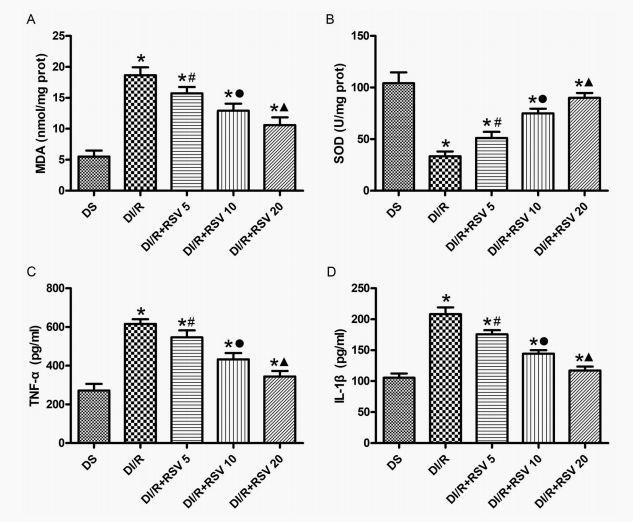
Figure 2. The effects of RSV on oxidative stress and inflammation after renal I/R. (A) MDA levels. (B) SOD activity. (C) TNF-α concentration. (D) IL-1β concentration. Data are expressed as mean±SD. *p<0.05 versus DS group; #p<0.05 versus DI/R group; ●p<0.05 versus DI/R+RSV 5 group; ▲p<0.05 versus DI/R+RSV 10 group. (Gong et al., 2026)
Conclusion & Implications
This study demonstrates that resveratrol protects diabetic kidneys from ischemia/reperfusion injury by reducing oxidative stress, inflammation, and apoptosis through modulation of the Nrf2/HO-1 and TLR4/NF-κB pathways, supporting its potential as a therapeutic strategy for diabetic renal injury research.
Related Resources
• Application Brochure: Metabolism Assay Kits for Oxidative Stress Brochure
• Experimental Videos: Total Antioxidant Status (TAS) Colorimetric Assay Kit Operation Guide, Total Oxidant Status (TOS) Colorimetric Assay Kit Operation Guide, Glutathione Peroxidase 4 (GPX4) Activity Assay Kit Operation Guide
• Technical articles: Role of Oxidative Stress-Induced Mitochondrial Dysfunction in Insulin Resistance and Type 2 Diabetes Mellitus
Citation Note
All studies referenced on this page are published by independent research groups.
Figures and data are summarized or adapted for clarity. For full experimental details, please refer to the original publications.
Full Literature References
[1] Gong, D., Chen, X., Dong, Z., Chen, H., & Liu, Z. (2026). Resveratrol inhibits renal ischemia and reperfusion injury in diabetes via reducing oxidative stress, inflammation, and apoptosis. Renal Failure, 48(1), 2652103.
[2] Bansal, R., Akhil, A., Kumari, P., Naura, A. S., & Bhatnagar, A. (2026). Oxidative Stress and Mitochondrial Dysfunction Contribute to Pulmonary Impairment in a Murine Model of Type 2 Diabetes Mellitus. Tissue and Cell, 103397.
[3] Xu, Y., & Zhang, Z. (2025). Vitamin C Augments the Protective Effects of Metformin on Diabetes-Induced Renal and Cardiac Complications Associated with the Inhibition of Oxidative and Nitrosative Stress and Dyslipidaemia As Well As Ameliorating Inflammation and Apoptosis. Bratislava Medical Journal, 126(8), 1812-1829.
[4] Naseeb, M., Albajri, E., Almasaudi, A., Alamri, T., Niyazi, H. A., Aljaouni, S. & Harakeh, S. (2024). Rutin promotes wound healing by inhibiting oxidative stress and inflammation in metformin-controlled diabetes in rats. ACS omega, 9(30), 32394-32406.
[5] Novoa, U., Soto, K., Valdés, C., Villaseñor, J., Treuer, A. V., & González, D. R. (2022). Tetrahydrobiopterin (BH4) supplementation prevents the cardiorenal effects of diabetes in mice by reducing oxidative stress, inflammation and fibrosis. Biomedicines, 10(10), 2479.
[6] Elsherbiny, N. M., Altemani, R., Althagfi, W., Albalawi, M., Mohammedsaleh, Z. M., El‐Sherbiny, M., & Abo El‐Magd, N. F. (2023). Nifuroxazide repurposing for protection from diabetes‐induced retinal injury in rats: implication of oxidative stress and JAK/STAT3 axis. Biofactors, 50(2), 360-370
[7] Mustafa, H. K., Rasul, K. H., Abdulrahman, A. S., Awla, H. K., Moshari, S., & Khidir, K. A. (2025). L-Carnitine Attenuates Testicular Dysfunction in Type 1 Diabetes Mellitus Via Modulation of Oxidative Stress, Inflammation, and miRNA Expression. Inflammation, 49(1), 8.
[8] Mahjabeen, W., Khan, D. A., & Mirza, S. A. (2022). Role of resveratrol supplementation in regulation of glucose hemostasis, inflammation and oxidative stress in patients with diabetes mellitus type 2: A randomized, placebo-controlled trial. Complementary therapies in medicine, 66, 102819.

