

Weak staining, low signal, unexpectedly high fluorescence in drug-treated groups, and protocol failure after switching cell batches are familiar challenges in ROS detection. ROS detection is widely used in oxidative stress research. Fluorescence probes are convenient and sensitive, but weak signals, reversed group trends, and poor reproducibility remain common. This guide summarizes practical lessons from our laboratory.
Table of Contents
1. Choose the right probe: identify the target ROS
2. Order of addition: match the stimulation time
3. Troubleshooting weak signal: identify the cause
4. Concentration optimization: avoid simply copying datasheet conditions
5. Avoiding false positives: rule out drug interference
6. Acquisition standardization: ensure data stability
01 Choose the right probe: identify the target ROS
Different probes detect different ROS species and have different subcellular localization. Choosing the wrong probe can lead to inaccurate conclusions.
Table 1. Common ROS Probes: Targets and Features
|
Probe |
Target |
Key features |
|
DCFH-DA |
Total ROS (overall oxidative level) |
Classic probe; non-fluorescent; enters cells and is hydrolyzed by esterases to DCFH, then oxidized by ROS to green fluorescent DCF; low cost but non-specific |
|
CM-DCFH-DA |
Total ROS (signal-enhanced) |
Structurally similar to DCFH-DA; higher intracellular retention; usually stronger fluorescence than DCFH-DA |
|
MitoSOX Red |
Mitochondrial superoxide anion (O2-•) |
Targets mitochondria; oxidized by superoxide to red fluorescence; a preferred choice for mitochondrial dysfunction and oxidative stress studies |
|
DHE (dihydroethidium) |
Intracellular superoxide anion |
Red fluorescence after reaction; mainly used to detect intracellular superoxide levels |
Recommendation: Choose the probe based on the scientific question, not simply the most common or cheapest option.
02 Order of addition: match the stimulation time
The order of probe loading and stimulus addition depends on stimulation duration and should be pre-set for each cell model.
● Short stimulation (≤ 2 h): Load the probe first, then add the stimulus. This allows the probe to enter cells and capture early rapid ROS peaks.
● Long stimulation (≥ 6 h): Add the stimulus first, then load the probe 30-60 min before detection. Prolonged incubation may cause probe decay or leakage.
● Intermediate duration (~ 4 h): Treat as long stimulation: stimulate first, then load.
For example, a positive control such as ROSup is generally incubated at 37°C in the dark for 20–30 min, but responses vary considerably by cell type: HeLa cells usually respond within 30 min, whereas MRC-5 human embryonic lung fibroblasts may require about 1.5 h. For routinely used cell lines, the positive control and probe can be co-incubated to save time.
03 Troubleshooting weak signal: identify the cause
If the signal after staining is markedly lower than expected, check the following:
● Is the probe working solution freshly prepared?
Aliquot stock solutions in the dark at −20°C and avoid repeated freeze–thaw cycles. Take one aliquot per use.
● Is serum removed completely?
Serum esterases can degrade the probe. Before loading, wash cells with prewarmed serum-free medium.
● Does the medium contain phenol red?
Phenol red causes background interference. Switching to phenol red-free HBSS or DMEM can markedly improve results.
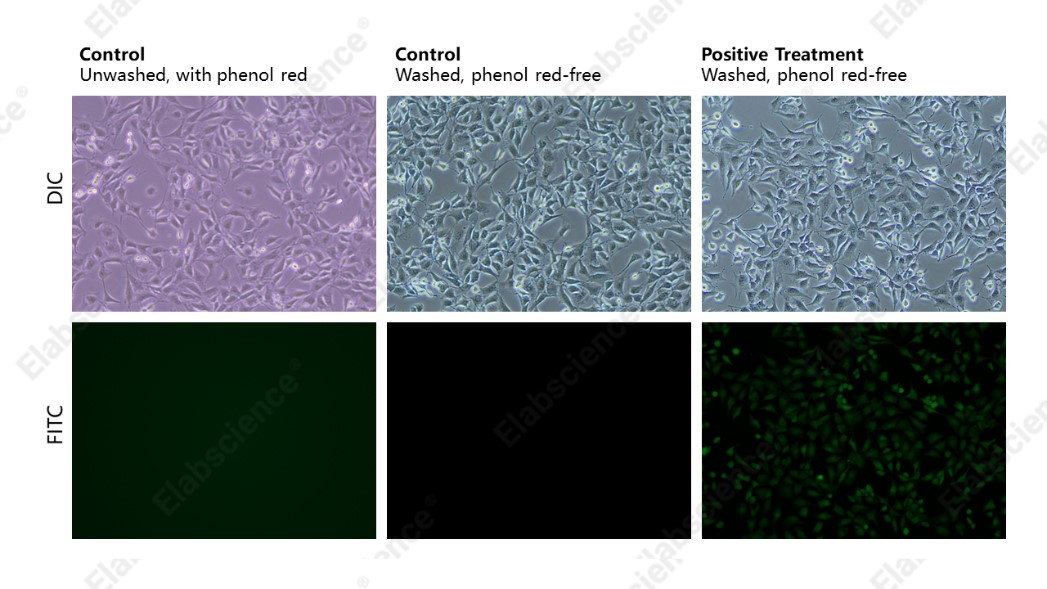
Fig. 1 FITC-channel fluorescence of DCFH-DA-stained cells without and with washing. The unwashed group showed markedly higher background, indicating that residual serum and phenol red can interfere with detection.
● Is incubation long enough?
For MitoSOX, the datasheet recommends 10 min, but many cell lines require 15–20 min; generally do not exceed 30 min, as probe accumulation can increase background.
● Is the probe protected from light throughout?
Protect from light starting from working solution dilution.
Run a pilot experiment with the kit’s positive control to determine staining time and detection conditions, familiarize yourself with the workflow, and then run formal samples. This avoids wasting samples and time.
04 Concentration optimization: avoid simply copying datasheet conditions
The datasheet concentration is only a starting point. Optimal concentration varies considerably with cell type, density, and state.
Practical approach:
(1) Use the datasheet concentration as the center.
(2) Test 2–3 concentration levels above and below it (e.g., 5, 10, and 20 μM for DCFH-DA).
(3) Select the concentration with the highest signal-to-noise ratio.
Note: Excessive concentration can cause probe accumulation, increased background, and potential cytotoxicity.
05 Avoiding false positives: rule out drug interference
If fluorescence in the drug-treated group is higher than in the model group, do not immediately reject the experiment. Possible causes include:
● The drug itself is fluorescent or redox-active (e.g., compounds with phenolic hydroxyl or quinone structures may directly oxidize the probe).
● The drug induces a stress-related ROS burst.
● Cell density or state is inconsistent between groups.
Include a “drug + probe + no cells” blank control to rule out direct drug–probe interaction. In addition, some probes may undergo photosensitive reactions under light; include a dark control in parallel.
06 Acquisition standardization: ensure data stability
● Flow cytometry
Normalize cell number, loading time, and acquisition time (DCF fluorescence decays over time); keep voltage and compensation settings fixed.
● Fluorescence imaging
Ensure identical exposure parameters across groups; image as soon as possible after staining. Confocal microscopy provides a better signal-to-noise ratio than widefield microscopy; prioritize it when conditions permit.
Reproducibility of ROS detection largely depends on three aspects:
(1) Rational probe selection;
(2) Correct order of operations
(3) Adequate elimination of interference.
Include positive, negative, and drug blank controls; strictly protect from light; use a serum-free system; and prepare working solutions fresh. These practices can substantially improve data stability. We hope this guide helps you avoid some of the pitfalls we have encountered. If you have your own tips or have encountered unusual troubleshooting cases, we welcome your comments and discussion.

