

In the research and cell therapy of tumor-infiltrating lymphocytes (TILs) in melanoma, how to efficiently isolate lymphocytes with high purity and high activity from the complex solid tumor microenvironment is the first step that determines the success of subsequent expansion and experiments.
When choosing density gradient centrifugation media, researchers often choose between Ficoll and Percoll. This choice not only reflects the difference between discontinuous and continuous gradients, but also directly affects cell yield and quality. This article will combine the literature to clarify the principles and mechanisms of the two, introduce their differences, and finally give appropriate choices.
Table of Contents
1. Principles of Ficoll and Percoll separation
2. Ficoll vs. Percoll for melanoma TIL isolation
3. Why Percoll is preferred for melanoma TIL isolation
4. Experimental considerations
01 Principles of Ficoll and Percoll separation
1.1 Principle of Ficoll's single-layer discontinuous gradient
Ficoll is a fixed-density solution made by mixing sucrose polymer with sodium diatrizoate, with a standard density of 1.077 g/mL. It is a typical discontinuous density gradient centrifugation medium.
During centrifugation, there are only two density layers in the entire centrifuge tube (the upper diluted sample solution and the lower Ficoll solution). When centrifugal force acts, all cells with a density less than 1.077 g/mL (such as peripheral blood mononuclear cells (PBMC), including lymphocytes and monocytes) cannot penetrate this barrier, and are eventually forced to suspend at the interface of the two solutions (commonly known as the "buffy coat"); while red blood cells and granulocytes with a density greater than 1.077 g/mL will settle to the bottom of the tube.
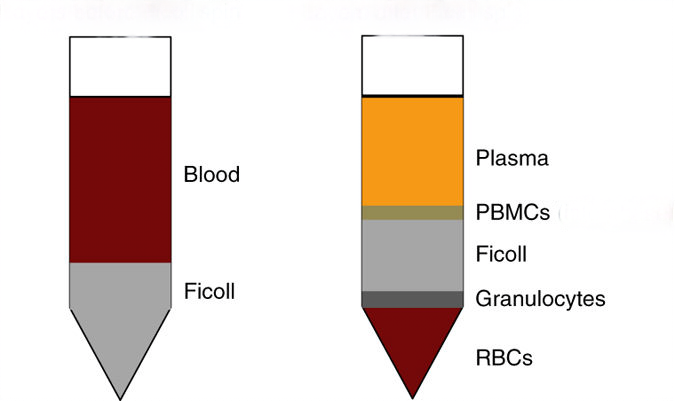
Fig. 1 Ficoll separation medium.
1.2 Principle of Percoll's continuous and multi-layer discontinuous gradient
Percoll is a suspension of silica particles coated with polyvinylpyrrolidone (PVP). It has extremely low viscosity and osmotic pressure, with a density between 1.0 and 1.13 g/mL, which is fully adjustable. Percoll can achieve separation in two ways:
Continuous Gradient: Under high-speed centrifugation, the silica particles in Percoll will automatically form a gradient with continuously and linearly increasing density from top to bottom.
Multi-layer discontinuous gradient: Dilute Percoll into different concentrations with isotonic solution (such as commonly used 40% and 70%), and layer them in a centrifuge tube to form multiple stepped density barriers.
Under this mechanism, cells are not simply blocked at a certain interface, but according to their own slight density differences, accurately settle and stay in the "isopycnic banding" area where their own density is exactly equal, achieving multi-target, multi-level precise screening.
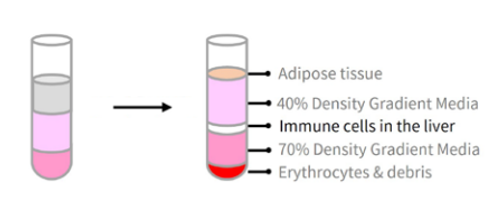
Fig. 2 Percoll separation medium.
02 Ficoll vs. Percoll for melanoma TIL isolation
When processing solid tumor tissues such as melanoma, there are essential differences in the performance of the two, mainly reflected in the following four aspects:
2.1 Different abilities to remove tissue debris and necrotic cells
After mechanical cutting and enzymatic digestion, melanoma produces a large amount of cell debris, dead cells, and free melanin granules. When using Ficoll, due to its high viscosity and single barrier, a large amount of dead cell debris cannot settle and will all accumulate at the 1.077 g/mL interface, contaminating TILs and resulting in low cell purity after washing. In contrast, Percoll (such as 40%/70% gradient) can retain dead debris in the 40% upper layer, while accurately intercepting live TILs at the interface between 40% and 70%, separating debris and dead cells.
2.2 Different interception effects on large tumor cells
Melanoma cells vary greatly in volume and density, and the density of some solid tumor cells is very close to that of lymphocytes. In Ficoll separation, these tumor cells will mix with lymphocytes in the buffy coat. Using the multi-stage gradient of Percoll, the slight density difference can be used to distinguish large melanoma cells from smaller TILs at different densities.
2.3 Different cell viability and osmotic damage
Due to its chemical composition, Ficoll solution has relatively high viscosity and non-physiological osmotic pressure; cells staying at the interface for too long are susceptible to shear force and osmotic damage. In contrast, Percoll has extremely low viscosity and isotonic properties, producing minimal mechanical friction on cells during centrifugation. The isolated TILs have more intact membrane structures, and cell viability is significantly better than with Ficoll.
2.4 Different operation procedures and fault tolerance
Ficoll is a "ready-to-use" reagent, which can be directly loaded with simple operation, but has extremely low fault tolerance for solid tumor samples (once tissue digestion is incomplete, it is very easy to cause clogging or layer mixing). Percoll needs to be prepared into an isotonic stock solution with 10× PBS before use, then diluted into different percentages for layering, and has extremely high tolerance and adjustment flexibility for digests of complex solid tumor samples.
03 Why Percoll is preferred for melanoma TIL isolation
In immunological research of melanoma and other solid tumors, researchers generally prefer to use the Percoll gradient centrifugation method, for the following reasons:
3.1 Significantly improve the recovery purity and viability of TILs, avoiding tumor debris contamination
The low viscosity and multi-gradient design of Percoll allows lymphocytes to be separated from necrotic stroma, free melanin, and large-volume tumor cells in melanoma, and its isotonic properties maximally preserve the proliferation potential of TILs in subsequent expansion.
3.2 Support multi-layer discontinuous gradient (such as 40%/70%) separation to achieve specific enrichment
By configuring 40% and 70% discontinuous Percoll interfaces, precise density differences can be used to settle red blood cells to the bottom of the tube, retain tumor cells in the uppermost layer, and enrich targeted mononuclear immune cells (T cells, NK cells, etc.) at the extremely narrow specific physical interface of 40%/70%.
04 Experimental considerations
4.1 Density gradient centrifugation prohibits rapid acceleration and deceleration
The instantaneous liquid convection generated by this operation will completely disperse the already separated Percoll or Ficoll cell layers.
4.2 Strictly maintain room temperature (18°C–20°C)
The density of the medium is extremely sensitive to temperature. It is prohibited to perform this operation in a 4°C refrigerated centrifuge, otherwise the solution viscosity will increase, causing lymphocytes to fail to settle to the predetermined position, resulting in experimental failure.

