

Table of Contents
1. Define your experimental needs
2. Compare common antibody types
3. Match the antibody type to your experimental needs
4. Verify the product before buying
5. See how antibody selection works in practice
6. Key takeaways
7. Related resources
Introduction
When an experiment fails, the antibody is often one of the first variables researchers reconsider. Choosing an antibody that fits your experimental needs can help support reliable and interpretable results. However, even with the same antibody, results may vary from one experiment to another.
So, how should you choose the right antibody?
The answer starts with a simple question: What does your experiment actually require?
A practical antibody selection process can be broken down into four steps: define your experimental needs, compare antibody types, match the antibody type to your requirements, and verify the specific product before buying.
01 Define your experimental needs
Before comparing antibody products, first define what your experiment requires. Four core factors should be considered: target antigen, application, sample type, and sensitivity and specificity requirements.
1.1 Target Antigen
First, clarify the specific target to be detected:
● Total protein or a specific post-translational modification?
● Endogenous protein or exogenously overexpressed protein?
● Reactivity: human, mouse, rat, or another species?
● Is it necessary to distinguish highly homologous proteins or different protein isoforms?
For example, when detecting phosphorylated proteins, ensure that the antibody specifically recognizes the target phosphorylation site rather than only the total protein. For mutant protein detection, verify whether the mutation affects the epitope recognized by the antibody.
The more precisely the target is defined, the more targeted the antibody selection process can be.
1.2 Application
Different assays impose different requirements on antibody performance. Prioritize antibodies that have been validated for your intended application.
● Western Blot (WB)
Strong, specific bands with low background.
● Immunohistochemistry (IHC)
Clear tissue staining for reliable target localization.
● Immunofluorescence (IF)
Specific cellular localization with a high signal-to-noise ratio.
● Flow Cytometry (FCM)
Reliable detection of cell-surface and intracellular markers.
● Immunoprecipitation (IP)
Efficient target enrichment for protein interaction studies.
1.3 Sample Type
Match the antibody's validated sample types to your experimental samples. Common sample types include cell lysates, tissue lysates, paraffin-embedded (FFPE) tissues, frozen tissues, plasma/serum, and cellular subfractions.
Different sample-processing procedures can alter antigen epitopes and affect antibody binding. For low-abundance target proteins or limited sample volumes, pay particular attention to the antibody's detection sensitivity and experimentally validated performance.
1.4 Sensitivity and Specificity Requirements
Adjust your selection criteria according to your experimental priorities.
For low-abundance target detection, prioritize antibodies with high sensitivity. For targets with highly homologous family members, focus on the antibody's specificity and its ability to distinguish the target protein from homologous proteins.
At this stage, the goal is not to choose a specific product, but to define the requirements that the antibody must meet.
02 Compare common antibody types
Once your experimental requirements are clear, the next step is to understand the characteristics of the main antibody types used in research.
Common formats include polyclonal antibodies, mouse monoclonal antibodies, and recombinant rabbit monoclonal antibodies.
Table 1. Key Characteristics of Common Antibody Types
|
Dimension |
Polyclonal Antibodies |
Mouse Monoclonal Antibodies |
Recombinant Rabbit Monoclonal Antibodies |
|
Epitope Recognition |
Multiple epitopes |
Single defined epitope |
Single defined epitope; sequence-defined |
|
Specificity |
Low (cross-reactivity) |
Moderate (single epitope) |
High (single epitope & conformational targeting ) |
|
Batch Consistency |
Poor (response varies by animal) |
Variable (hybridoma drift) |
Excellent (sequence-defined ) |
|
Production Basis |
Immunized animals |
Hybridoma cells |
Recombinant expression (Animal-Origin-Free Production) |
|
Traceability |
Hard to fully trace |
Partially traceable |
Fully traceable with clear gene sequences |
2.1 Polyclonal Antibodies
Polyclonal antibodies are heterogeneous antibody populations that recognize multiple epitopes on the same antigen. This broad epitope recognition can provide greater tolerance to some changes in antigen structure or epitope accessibility and may be beneficial in applications where recognition of multiple epitopes is advantageous.
However, polyclonal antibodies can show greater lot-to-lot variability because the antibody composition depends on the biological response of individual immunized animals.
2.2 Mouse Monoclonal Antibodies
Traditional mouse monoclonal antibodies are commonly generated using hybridoma technology. Derived from a single antibody-producing clone, they provide defined epitope recognition and can offer consistent target recognition across production batches.
However, long-term supply depends on the preservation and maintenance of the antibody-producing cell line. Changes in the production cell line or manufacturing process may affect long-term consistency or availability.
2.3 Recombinant Rabbit Monoclonal Antibodies
Recombinant antibody technology uses defined antibody gene sequences to support controlled antibody production. Unlike antibody production that depends on maintaining an antibody-producing cell line, recombinant production can use sequence-defined antibody genes as the basis for manufacturing.
Key advantages include:
● Defined antibody sequences for reproducible production
● Controlled manufacturing processes to support batch consistency
● Sequence preservation to support long-term production
● Documented production information to support product traceability
The specific performance of any recombinant antibody still depends on its antibody sequence, target, application, and experimental validation.
03 Match the antibody type to your experimental needs
There is no "one-size-fits-all" best antibody. The appropriate choice depends on how well the antibody's characteristics match your experimental requirements.
3.1 If recognition of multiple epitopes is important
Polyclonal antibodies recognize multiple epitopes on the same antigen and may be useful when broad epitope recognition is beneficial for the intended assay.
3.2 If defined target recognition is important
Monoclonal antibodies/recombinant monoclonal antibodies recognize a defined epitope and can provide more consistent and specific target recognition.
3.3 If reproducibility is a priority
Consider antibodies with defined sequences and controlled production processes. Recombinant monoclonal antibodies can support reproducible manufacturing by using a defined antibody sequence as the production template.
3.4 If multiple experiments or long-term studies are planned
Recombinant monoclonal antibodies may be suitable when sequence definition, production consistency, and long-term availability are important considerations.
The key is to match the antibody characteristics to the requirements defined in Section 1, rather than selecting an antibody solely by brand, price, or antibody type.
04 Verify the product before buying
After identifying the antibody characteristics that fit your experiment, move from antibody type selection to specific product verification.
Product-specific validation data are critical for determining whether an antibody is suitable for your experiment. Before purchasing, check the following.
4.1 Reactivity and Sample Type
Confirm that the antibody has been validated for your experimental species and sample type.
For example:
Mouse tissue ≠ human tissue
Cell lysate ≠ FFPE tissue
Overexpression samples ≠ endogenous samples
The same target does not necessarily mean that an antibody will perform equally well across different species, sample types, or sample-processing conditions.
4.2 Application
Before purchasing, check whether the antibody has been validated for your intended application, such as WB, IHC, IF, mIHC, IP, or FCM.
● An antibody validated for WB, for example, may not perform equivalently in IF because the two applications involve different sample preparation, epitope accessibility, and detection conditions.
● For applications such as IHC, IF, IP/Co-IP, and flow cytometry, evaluate specificity and signal-to-background performance using application-specific validation data.
4.3 Product-Specific Validation Data
Before making a final selection, review the available product-specific validation data, including the validated application, species, sample type, sample-processing conditions, and experimental results.
Monoclonal antibodies can provide more consistent recognition of a specific epitope, but their suitability should be evaluated based on product-specific validation data and your experimental requirements.
05 See how antibody selection works in practice
The following examples illustrate how the selection process can be applied to specific research needs.
5.1 Multi-Species IHC Detection of Vimentin
Experimental Requirements
● Target: Vimentin/VIM
● Reactivity: Human, mouse, rat
● Application: IHC
● Samples: Multiple application-specific validated colon
What to Check
Because the experiment involves IHC across multiple species, check whether the antibody has been validated for the intended application, tissue type, and species.
Product Example:
Recombinant Vimentin/VIM Monoclonal Antibody
Cat. No.: AN300103P
Reactivity: Human, mouse, rat
Application: WB, IHC, ICC/IF, FC
Verified Samples: in WB: HCT116, HeLa, Jurkat, A549, A431, NIH/3T3, Mouse brain, Mouse heart, PC12, Rat brain, Rat heart; in IHC: Human colon, mouse colon, rat colon; in IF: HeLa
Verification result (Partial):%20analysis%20of%20paraffin-embedded%20colon%20tissues%20using%20Vimentin%20VIM%20Antibody_.jpg)
Fig. 1 Immunohistochemical (IHC) analysis of paraffin-embedded colon tissues using Vimentin/VIM Antibody. (A: Human colon; B: Mouse colon; C: Rat colon)
5.2 Multi-Application Detection of α-SMA
Experimental Requirements
● Target: α-SMA
● Reactivity: Human
● Applications: WB, IF, IHC
● Samples: Multiple application-specific validated samples
What to Check
Because the experiment involves multiple applications, check whether the antibody has been validated separately for each intended application and relevant sample.
Product Example:
Recombinant alpha smooth muscle Actin Monoclonal Antibody
Cat. No.: AN301435L
Reactivity: Human, mouse, rat
Application: WB, IHC, IF, FCM, IP
Verified Samples: in WB: MCF-7, HeLa, A431, HEK-293, NIH-3T3, Rat colon, Mouse colon; in IHC: Human prostate hyperplasia, Mouse stomach, Rat stomach; in IF: HeLa, C6; in FCM: HeLa, Jurkat; in IP: HeLa cells extracts
Verification result (Partial):
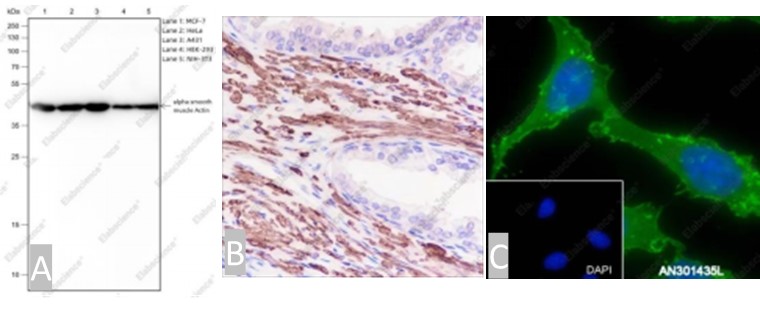
Fig. 2 Multi-application detection of alpha smooth muscle Actin Antibody. (A: WB analysis in multiple cells; B: IHC staining in human prostatic hyperplasia; C: IF staining in HeLa)
Find the Right Antibody for Your Research
Explore Elabscience® Rabbit Monoclonal Antibodies and validated solutions for different applications.
Special Offer: Buy 2, get 3rd free丨Available from Sep 21 to Nov 30, 2026. View Promotion →
06 Key takeaways
● Start with the experiment, not the antibody type. Define your application, sample type, target, and key experimental requirements first.
● Choose based on application compatibility. An antibody that recognizes your target is not necessarily suitable for your specific application.
● Consider antibody type as part of the selection process. Polyclonal, monoclonal, and recombinant monoclonal antibodies have different characteristics that may suit different experimental needs.
● Prioritize product-specific validation data. Check application-specific validation, target species compatibility, sample type, and relevant experimental evidence before making a selection.
● Consider performance beyond specificity. Signal quality, background, working concentration, lot-to-lot consistency, and reproducibility can all affect experimental outcomes.
A practical selection workflow:
Define the research question → Identify suitable antibody options → Consider performance and practical requirements → Select and validate
07 Related resources
● Explore the molecular and functional differences between recombinant rabbit monoclonal antibodies (mAbs) and two widely used traditional antibody formats.
● Learn key steps for antibody-based assays with practical guidance on WB, IHC, and IP/Co-IP workflows.
Watch Antibody Operation Guide Videos →
References:
[1] Uhlen M, et al. Nature Biotechnology, 2025, 43(2): 187-196. (Antibody performance benchmark study).
[2] Edfeldt K, et al. Journal of Immunological Methods, 2023, 516: 113487. (Rabbit immune repertoire diversity analysis).
[3] RabMAb® Technology Whitepaper, Abcam plc, 2024. (Epitope recognition performance comparison).
[4] National Institutes of Health (NIH). Antibody Validation Framework for Biomedical Research, 2024. (Recombinant antibody reproducibility standards)
[5] Nature Antibody Reproducibility Survey, 2025: Global annual research waste due to poor antibody quality exceeds $350 million.

